Not every thought on the Middle East merits an entire post.
***
As'ad AbuKhalil of Angry Arab once said that the summer 2006 war in Lebanon is better thought of as a continuation of Israel's continuous state of war with the Arab world since its inception in 1948 than as an isolated conflict. Fighting became more continuous in 1948, but the war was actually declared in 1895 when Herzl, and the European Jews Herzl represented, declared that a territory that they knew at the time to be over 95% Arab would be a Jewish homeland regardless of the wishes of the inhabitants. The Zionist War was declared in 1895 and low level fighting had begun by at latest 1935. AbuKhalil is right that the 2006 conflict is part of the Zionist War, but the starting date of that war was not really 1948. [Note: If I ever expand this to an entire post, I'll make sure Herzl's declaration was really 1895 and not 1894 or 1896.]
***
I am really annoyed that Abbas of Palestine is rejecting Hamas proposals himself. Why should he not present these proposals to Europe and have them reject them officially, then go back to Hamas? Why should he not force the leaders of Egypt, Saudi Arabia and Jordan to publicly say, for example, that a Hudna is not acceptable, instead of Abbas saying it for them. I am happy that Abbas does not seem inclined to militarily confront Hamas at least for now. I am disappointed that he would rather be a spokesperson for Israel confronting Hamas than be a spokesperson for Hamas confronting Israel.
I mean Hamas, you know, won the election. I should say Abbas is a spokesperson for Israel confronting the Palestinian people rather than a spokeperson for the Palestinian people confronting Israel. Abbas could be worse, and throughout history traitors worse than Abbas are far from unusual, but I still find him very disapointing in this issue.
***
Guerillas, insurgents and militias in Iraq could have a lot more shoulder fired ground to air missiles than they do. Iran produces these missiles domestically. I can think of three helicopter downings since 2003. If the US really wants a confrontation with Iran, we will certainly be seeing three downings a month by summer 2008. US voters would not tolerate that and the US would be out Saigon style by March 2009. From the US point of view, it would be much better to talk it out.
***
In 2003, I thought it was immoral for the US to invade Iraq, and cause the damage to civilians that is inevitable in such an invasion when the aim of the invasion was indirectly to make the Middle East more safe for Zionism. Today, I still think it was immoral. I still think the purpose of the war was to directly eliminate a threat to Israel and indirectly to ensure that Iraq does not threaten the pro-US authoritarian governments that are relatively non-hostile to Israel.
Specifically in the case of Saudi Arabia, a nationalist government could still sell oil to the US, and could well still have closer ties with the US than anyone else. But it could not refrain from funding Hamas and other Palestinian groups and could not even tacitly ally with Israel.
But now I see that the best reason not to invade was that it can't work. I didn't realize that then. A hostile population is very difficult to put under a friendly government by force. It becomes impossible if the country has neighbors like Iran and Syria that are willing to help the population fight back. If I had known in 2003 that defeat for the US in Iraq was inevitable, I still would have opposed the invasion.
***
A major reason democracy is an advance is that a group that becomes more powerful than its rivals has a non-violent way of attaining control of government - and does not have to wage a war that it probably could win.
When pro-Iran elements won the elections - even though Iraq was under direct US occupation and the US was flooding Iraq's electoral system with money, free television and other resources - the whole point of democracy is that now the pro-Iran elements don't have wage the war they probably could win.
America is now saying it wants to fight the pro-Iran elements even after the pro-Iran elements won the elections. That defeats the entire purpose of elections, and the pro-Iran elements are probably (definitely) going to win anyway, just like they won the elections.
Somebody should teach the United States about democracy. It sounds ironic but it is not a joke. US ideals about democracy are consistently put to the test in the Middle East and the US consistently, not just Bush but consistently for over 50 years, demonstrates that it does not understand or accept the theoretical underpinnings or consequences of democracy.
Sunday, January 21, 2007

Friday, January 19, 2007
Middle East Goings On, and the Honesty of Robert Gates
There is not much new happening in the Middle East right now.
Lebanon is at a stalemate until the next elections, whenever those are. There will be no governmental moves until then against either Syria through the Hariri tribunal or against Hezbollah through a disarmament policy. Hezbollah apparently feels comfortable waiting for elections if it has to. If Israel is smart it will not launch a new war this summer that would certainly immediately topple Saniora. There also will not be sonic booms over Lebanese territories. The cluster bombs were a mistake that are going to give Hezbollah a constant stream of martyrs from now until the elections, whenever they are.
Palestine is at a stalemate. I am very pleased that Abbas has not escalated a civil war. Dahlan talks as if he would have done so by now. I never thought much of Abbas but as obsequious as he is, there are limits. The presidential elections are scheduled for before the next parliamentary elections. Israel needs for the elections to be at least at the same time. We'll see how he handles that later, but for now things are essentially quiet.
Syria is also at a stalemate. All the pressure the US can bring to bear on the country has already been brought. The recent release of terms for peace with Israel was designed to embarrass both sides and did so.
Pro-US Arabs are trying desperately for at least the appearance of movement on the Palestinian issue. They are not getting it. Abbas isn't playing along as well as they wanted him to.
Internally Iran has moved against Ahmadinejad - and may actually be preparing to sacrifice him to tone down tensions with Europe. Iran has so far acted very cleverly, and while it will not give up enrichment or Iraq (more later) if Ahmadinejad the personality is important to Europe, Iran will sack him in exchange for concessions on trade relations.
Iraq - right now is quiet, but the US looks like its planning fireworks there. Here is where Robert Gates comes closer to brutal honesty than any American leader speaking on Iraq has done publicly so far.
Another quote.
Of course the problem is that Iraq's citizens voted directly, all of its leaders speak. It is crystal clear that Iraq does not want to be either a barrier against Iran or for US to have a strong military position there for a long time.
The Saudis do want the US there for a long time. The reason is that the Saudis nearly completely deny political power to the millions of Shiites who live in Saudi Arabia in its oil producing region. A direct link of Saudi Shiites to Iraq's pro-Iranian Shiites is the biggest possible risk that country can face. It is a risk comparable to the risk of an independent Kurdistan to Turkey.
Jordan is in a similar situation that its powerless and oppressed citizens would be aided by Iraq if the US was not there and would constitute a grave, eventually fatal threat to the authoritarian monarchy.
So the people of Iraq, who are far less anti-Iranian than anti-US have to be overruled, permanently - which means that any pretense of democracy is now of the past.
Of course the US never invaded Iraq to bring democracy but when speaking publicly, the story has always been that the sovereign Iraq would hopefully choose good relations with the US and may need a US military presence at its own discretion for some indefinite period.
The official story has now changed to the US will maintain a military presence for its own reasons for the foreseeable future, regardless of the wishes of any Iraqis.
Can the US pull this off? I doubt it. We can be sure that by summer 2008, Iran will ensure that US deaths in Iraq increase to an intolerable level for US voters even if otherwise that level would have stablized. Then the majority of Americans who want the US out will both increase in size and punish the Republicans in the election. It may reach the point that even Barack Obama could win.
What happens when the US leaves?
Where would the Saudis find protection? Iran. Iran's proposal to the Saudis is that if the Saudis go along with getting rid of the Americans we'll negotiate directly with you about your Shiites and come up with a compromise that leaves you in power, at least for a substantial amount of time. A long-term hudna similar to what Hamas offers Israel with the understanding that it can be done peacefully but eventually the situation has to change. Iran will also ensure that the Saudis become nuclear capable. There is no question that Saudi Arabia can sell its oil without the Americans.
The Saudis will not accept Iran's offer until there is no chance that America will remain in Iraq to help the Saudis stay in power with no concessions to the Shiites. Why is America on the Saudi side against the Shiites? Because a legitimate Saudi government would be much more hostile to Israel. It would sell the same oil for the same price, but it would fund Hamas and take other actions of that nature.
So now we are set for the fireworks. The Americans have to make sure Iran is not capable of pushing up US casualties by summer 2008. That has to fail because there are many, many parties in Iraq that would like nothing more than a spike in casualties that gets the US to leave. But in the process, the US has to declare all-out war with Iran over Iraq or the Saudis will leave the US camp immediately.
Lebanon is at a stalemate until the next elections, whenever those are. There will be no governmental moves until then against either Syria through the Hariri tribunal or against Hezbollah through a disarmament policy. Hezbollah apparently feels comfortable waiting for elections if it has to. If Israel is smart it will not launch a new war this summer that would certainly immediately topple Saniora. There also will not be sonic booms over Lebanese territories. The cluster bombs were a mistake that are going to give Hezbollah a constant stream of martyrs from now until the elections, whenever they are.
Palestine is at a stalemate. I am very pleased that Abbas has not escalated a civil war. Dahlan talks as if he would have done so by now. I never thought much of Abbas but as obsequious as he is, there are limits. The presidential elections are scheduled for before the next parliamentary elections. Israel needs for the elections to be at least at the same time. We'll see how he handles that later, but for now things are essentially quiet.
Syria is also at a stalemate. All the pressure the US can bring to bear on the country has already been brought. The recent release of terms for peace with Israel was designed to embarrass both sides and did so.
Pro-US Arabs are trying desperately for at least the appearance of movement on the Palestinian issue. They are not getting it. Abbas isn't playing along as well as they wanted him to.
Internally Iran has moved against Ahmadinejad - and may actually be preparing to sacrifice him to tone down tensions with Europe. Iran has so far acted very cleverly, and while it will not give up enrichment or Iraq (more later) if Ahmadinejad the personality is important to Europe, Iran will sack him in exchange for concessions on trade relations.
Iraq - right now is quiet, but the US looks like its planning fireworks there. Here is where Robert Gates comes closer to brutal honesty than any American leader speaking on Iraq has done publicly so far.
In meetings late Wednesday with King Abdullah of Saudi Arabia, Mr. Gates said the United States viewed Iraq, despite the close ties between some in its Shiite-dominated government and Shiite Iran, as a bulwark against Tehran, said a senior Defense Department official.
“Our Arab friends tend to see Iraq in the context of the new challenge from Iran,” the official said. “That’s clearly the Saudi perspective. So the secretary was able to reassure them that we want an Iraq that is a barrier against Iranian expansionism.”
Another quote.
So the opportunity is there for engagement, but I would say that the initiative needs to rest with the Iranians and we are simply trying to communicate to the region that we're going to be there for a long time.
Of course the problem is that Iraq's citizens voted directly, all of its leaders speak. It is crystal clear that Iraq does not want to be either a barrier against Iran or for US to have a strong military position there for a long time.
The Saudis do want the US there for a long time. The reason is that the Saudis nearly completely deny political power to the millions of Shiites who live in Saudi Arabia in its oil producing region. A direct link of Saudi Shiites to Iraq's pro-Iranian Shiites is the biggest possible risk that country can face. It is a risk comparable to the risk of an independent Kurdistan to Turkey.
Jordan is in a similar situation that its powerless and oppressed citizens would be aided by Iraq if the US was not there and would constitute a grave, eventually fatal threat to the authoritarian monarchy.
So the people of Iraq, who are far less anti-Iranian than anti-US have to be overruled, permanently - which means that any pretense of democracy is now of the past.
Of course the US never invaded Iraq to bring democracy but when speaking publicly, the story has always been that the sovereign Iraq would hopefully choose good relations with the US and may need a US military presence at its own discretion for some indefinite period.
The official story has now changed to the US will maintain a military presence for its own reasons for the foreseeable future, regardless of the wishes of any Iraqis.
Can the US pull this off? I doubt it. We can be sure that by summer 2008, Iran will ensure that US deaths in Iraq increase to an intolerable level for US voters even if otherwise that level would have stablized. Then the majority of Americans who want the US out will both increase in size and punish the Republicans in the election. It may reach the point that even Barack Obama could win.
What happens when the US leaves?
President Bush gravely warned House Democrats yesterday that America's credibility would be shattered if the United States pulled its troops from Iraq, forcing close ally Saudi Arabia to look elsewhere for protection and potentially destabilizing Egypt, the region's most populous country, according to participants in the meeting.
...
Bush did not say during the half-hour meeting with Democrats where else he thought Saudi Arabia would seek "protection," but he made it clear that he was simply informing Democrats of his decisions on Iraq, not consulting with them.
Where would the Saudis find protection? Iran. Iran's proposal to the Saudis is that if the Saudis go along with getting rid of the Americans we'll negotiate directly with you about your Shiites and come up with a compromise that leaves you in power, at least for a substantial amount of time. A long-term hudna similar to what Hamas offers Israel with the understanding that it can be done peacefully but eventually the situation has to change. Iran will also ensure that the Saudis become nuclear capable. There is no question that Saudi Arabia can sell its oil without the Americans.
The Saudis will not accept Iran's offer until there is no chance that America will remain in Iraq to help the Saudis stay in power with no concessions to the Shiites. Why is America on the Saudi side against the Shiites? Because a legitimate Saudi government would be much more hostile to Israel. It would sell the same oil for the same price, but it would fund Hamas and take other actions of that nature.
So now we are set for the fireworks. The Americans have to make sure Iran is not capable of pushing up US casualties by summer 2008. That has to fail because there are many, many parties in Iraq that would like nothing more than a spike in casualties that gets the US to leave. But in the process, the US has to declare all-out war with Iran over Iraq or the Saudis will leave the US camp immediately.
Sunday, December 24, 2006
Sanctions on Iran
The press outlet of the National Council of Resistance of Iran wins the prize for first news source on Google to produce the entire text of UN Security Council Resolution 1737 which imposes sanctions on Iran. Later it will get to the UNSC website.
No surprises. Every country is to create its own laws to prevent Iran from getting enrichment, heavy water reactor and nuclear missile technology. No authorization for US interdiction of Iranian shipping. No travel bans. Asset freezes that are the responsibility of each individual country and relatively easy to get around. The first draft had been just a propaganda tool from the start. Of course, the US could have gotten this resolution in September.
The Western press during the summer would say that a Chapter 41 resolution had been committed to, and that Chapter 41 resolutions could include things like travel bans and asset freezes. Chapter 41 resolutions also can exclude travels bans and asset freezes and include sentences such as "we call on every country to impose voluntary sanctions". As I predicted, we got the second kind of resolution.
There is also a provision that IAEA will report in 60 days that Iran has not suspended its program. I have not seen any indication that Russia has made a commitment to new sanctions or to tighten current sanctions. If the price for this resolution was the US promise to come to the table, the price for the next resolution may be that the US has to offer to suspend part of its unilateral sanctions for the duration of talks.
Actually there is one surprise to me. The resolution is more emphatic than I expected on the bans of Iranian exports of technology. It seems to me the targets are Syria, Saudi Arabia and Egypt - two of them Sunni countries that the US press somehow believes are in a life and death struggle against Iran, but that Iran has offered to supply its fuel cycle knowledge to.
I don't think export bans will have any effect on the political situation. The countries would not buy magnets or centrifuges from Iran, they would buy them from Pakistan, China or Europe. There are some people named who, by this resolution, these countries should inform the sanctions committee of personal visits that could help a nuclear program, but these days they can videoconference. Before they could have sent deputies.
When Iran offers the fuel cycle to, for example, Egypt or Saudi Arabia it puts those countries in a bind. The only reason to turn such an offer down is pressure from Israel through the US. Now Iran's mission has been accomplished - a free increase in the cost Egypt and the Saudis bear to maintain their relationships with the US.
Syria on the other hand, will probably take Iran up on this offer next time it has a little cash to work with. The sanctions resolution will have little effect in preventing that.
No surprises. Every country is to create its own laws to prevent Iran from getting enrichment, heavy water reactor and nuclear missile technology. No authorization for US interdiction of Iranian shipping. No travel bans. Asset freezes that are the responsibility of each individual country and relatively easy to get around. The first draft had been just a propaganda tool from the start. Of course, the US could have gotten this resolution in September.
The Western press during the summer would say that a Chapter 41 resolution had been committed to, and that Chapter 41 resolutions could include things like travel bans and asset freezes. Chapter 41 resolutions also can exclude travels bans and asset freezes and include sentences such as "we call on every country to impose voluntary sanctions". As I predicted, we got the second kind of resolution.
There is also a provision that IAEA will report in 60 days that Iran has not suspended its program. I have not seen any indication that Russia has made a commitment to new sanctions or to tighten current sanctions. If the price for this resolution was the US promise to come to the table, the price for the next resolution may be that the US has to offer to suspend part of its unilateral sanctions for the duration of talks.
Actually there is one surprise to me. The resolution is more emphatic than I expected on the bans of Iranian exports of technology. It seems to me the targets are Syria, Saudi Arabia and Egypt - two of them Sunni countries that the US press somehow believes are in a life and death struggle against Iran, but that Iran has offered to supply its fuel cycle knowledge to.
I don't think export bans will have any effect on the political situation. The countries would not buy magnets or centrifuges from Iran, they would buy them from Pakistan, China or Europe. There are some people named who, by this resolution, these countries should inform the sanctions committee of personal visits that could help a nuclear program, but these days they can videoconference. Before they could have sent deputies.
When Iran offers the fuel cycle to, for example, Egypt or Saudi Arabia it puts those countries in a bind. The only reason to turn such an offer down is pressure from Israel through the US. Now Iran's mission has been accomplished - a free increase in the cost Egypt and the Saudis bear to maintain their relationships with the US.
Syria on the other hand, will probably take Iran up on this offer next time it has a little cash to work with. The sanctions resolution will have little effect in preventing that.
Thursday, December 14, 2006
Explaining Ahmadinejad and the Holocaust conference
To understand the Holocaust conference, most Westerners have to understand one or two other things first.
1- Iran makes Israel nervous. Iran does not border Israel, but is able to establish relations with groups that do. What that means is that Israel cannot seize land from Iran and really does not have a good way to pressure the country. Iran, compared to Israel's neighbors, therefore has an advantage in an assymetrical struggle with Israel. This means that as long as Iran is not ruled by the Shah, or by an unpopular pro-Western dictator, supporters of Israel want to see Iran isolated and contained to whatever degree is possible under any available pretext.
2- Iran is ruled by true believers. There is a cousin to fatalism, which is the belief that all you have to do is tell the truth as you believe it and God will take care of everything else. Ahmadinejad knows that there will be negative press about the conference, but for a religious true believer, in the long term, God will ensure that following this course benefits Ahmadinejad and Iran.
Ahmadinejad's speeches and actions are consistently skewed by supporters of Israel to provide a pretext for increasing Iran's isolation. On the other hand, Iran philosophically cannot retract or hesitate to make statements it sees as true out of fear of the reaction.
Ahmadinejad's basic thesis is that the story of the Holocaust is wrongly used to justify the oppression of the Palestinians. Further, there is a general atmosphere of political intimidation has arisen around discussions of the Holocaust. This atmosphere -- in which there are places where you can legally write a book directly encouraging people to join the Nazi party, but you cannot write a book questioning the number of Jews who were killed in the Holocaust -- victimizes the Palestinians, the Arabs and the Muslim world for whom a main basis for their oppression is a taboo subject.
In true believer thinking, there will initially be a lot of screaming as these taboos are faced head on, but the taboos will break and Iran will be stronger in the end. Belief in this is related to faith in God.
Ahmadinejad has not publically expressed any theory about how many Jews were killed by Germany in WWII. There is a magic number of 6 million that Ahmadinejad has not explicitly endorsed but he has also never said that the actual number was less.
Ahmadinejad made a statement that the West has elevated the story of the Holocaust above the story of God and the prophets so that it is possible to actually be imprisoned in the West for denying the first story. Maybe Ahmadinejad used a term in Farsi that corresponds to "myth", maybe the folks at MEMRI chose the most provocative possible translation. The point of the sentence in any event is not that the story of the Holocaust is not true. The point of that statement is that the West is hypocritical in assigning the questioning of the story of the Holocaust, and only that story, a status other cultures assign only to blasphemy against God.
So now when we read the word Ahmadinejad in the Western press, we read "myth, myth, myth, myth, myth". From that word we are told that Ahmadinejad claims no Jews were killed. He never made that claim. Then we are told that Ahmadinejad believes that if Jews had been killed it would have been a good thing. Ahmadinejad has consistently said the opposite. We are told that Ahmadinejad intends to use nuclear weapons to wipe Israel off the map. He has said many, many times that Israel will be wiped off the map by refugees returning and voting for a non-Zionist state. He has compared his expected dissolution of Israel more than once to the dissolution of the USSR and of the Shah's government of Iran.
But we never read a response to Ahmadinejad's real points. Is there, and should there be a special status for the story of the Jewish Holocaust that does not extend to, for example the story of slavery, the stories of other genocidal events, the stories of other victims during World War II or the stories of victims of other political movements, for example those victimized by the Zionist political project? Secondly, does the Holocaust justify the position that Palestinian refugees should never be able to return to Israel, and if so, how?
The point of the Holocaust conference to true believers is that the West may avoid Ahmadinejad's real points for as long as it can. But eventually, through Iran's steadfast faith in God and the truth, the West will be forced face his real points. When the actual points Ahmadinejad is trying to make are addressed, Ahmadinejad's position on those points will then win, making Iran stronger than ever.
1- Iran makes Israel nervous. Iran does not border Israel, but is able to establish relations with groups that do. What that means is that Israel cannot seize land from Iran and really does not have a good way to pressure the country. Iran, compared to Israel's neighbors, therefore has an advantage in an assymetrical struggle with Israel. This means that as long as Iran is not ruled by the Shah, or by an unpopular pro-Western dictator, supporters of Israel want to see Iran isolated and contained to whatever degree is possible under any available pretext.
2- Iran is ruled by true believers. There is a cousin to fatalism, which is the belief that all you have to do is tell the truth as you believe it and God will take care of everything else. Ahmadinejad knows that there will be negative press about the conference, but for a religious true believer, in the long term, God will ensure that following this course benefits Ahmadinejad and Iran.
Ahmadinejad's speeches and actions are consistently skewed by supporters of Israel to provide a pretext for increasing Iran's isolation. On the other hand, Iran philosophically cannot retract or hesitate to make statements it sees as true out of fear of the reaction.
Ahmadinejad's basic thesis is that the story of the Holocaust is wrongly used to justify the oppression of the Palestinians. Further, there is a general atmosphere of political intimidation has arisen around discussions of the Holocaust. This atmosphere -- in which there are places where you can legally write a book directly encouraging people to join the Nazi party, but you cannot write a book questioning the number of Jews who were killed in the Holocaust -- victimizes the Palestinians, the Arabs and the Muslim world for whom a main basis for their oppression is a taboo subject.
In true believer thinking, there will initially be a lot of screaming as these taboos are faced head on, but the taboos will break and Iran will be stronger in the end. Belief in this is related to faith in God.
Ahmadinejad has not publically expressed any theory about how many Jews were killed by Germany in WWII. There is a magic number of 6 million that Ahmadinejad has not explicitly endorsed but he has also never said that the actual number was less.
Ahmadinejad made a statement that the West has elevated the story of the Holocaust above the story of God and the prophets so that it is possible to actually be imprisoned in the West for denying the first story. Maybe Ahmadinejad used a term in Farsi that corresponds to "myth", maybe the folks at MEMRI chose the most provocative possible translation. The point of the sentence in any event is not that the story of the Holocaust is not true. The point of that statement is that the West is hypocritical in assigning the questioning of the story of the Holocaust, and only that story, a status other cultures assign only to blasphemy against God.
So now when we read the word Ahmadinejad in the Western press, we read "myth, myth, myth, myth, myth". From that word we are told that Ahmadinejad claims no Jews were killed. He never made that claim. Then we are told that Ahmadinejad believes that if Jews had been killed it would have been a good thing. Ahmadinejad has consistently said the opposite. We are told that Ahmadinejad intends to use nuclear weapons to wipe Israel off the map. He has said many, many times that Israel will be wiped off the map by refugees returning and voting for a non-Zionist state. He has compared his expected dissolution of Israel more than once to the dissolution of the USSR and of the Shah's government of Iran.
But we never read a response to Ahmadinejad's real points. Is there, and should there be a special status for the story of the Jewish Holocaust that does not extend to, for example the story of slavery, the stories of other genocidal events, the stories of other victims during World War II or the stories of victims of other political movements, for example those victimized by the Zionist political project? Secondly, does the Holocaust justify the position that Palestinian refugees should never be able to return to Israel, and if so, how?
The point of the Holocaust conference to true believers is that the West may avoid Ahmadinejad's real points for as long as it can. But eventually, through Iran's steadfast faith in God and the truth, the West will be forced face his real points. When the actual points Ahmadinejad is trying to make are addressed, Ahmadinejad's position on those points will then win, making Iran stronger than ever.
Saturday, December 02, 2006
Selected Poll data from Lebanon
Parts of a poll were released recently. The poll is entitled:
Lebanese Public Opinion Amidst a New Cycle of Violence
First, a word about the questions that do not appear in the summary posted on the web. Obvious ones are missing such as: Do you support Hezbollah? Which domestic leader do you most admire Nasrallah, Seniora, Aoun, etc. Polls are not being made available in English that directly ask Lebanese the most important questions about Lebanon's future. I believe that pollsters at least have an idea of the results these polls would yield and have made a decision to protect their customers from some realities.
Second, I predicted that Nasrallah would not attempt to bring down the government but instead the government in place would support Nasrallah's program. My prediction has turned out wrong. I underestimated the capacity of Lebanon's government to ignore public opinion in favor of pressure from the US.
But now here are some results that are approximations based on bar charts in the linked pdf. Hopefully Brookings will release the entire poll at some point with actual numbers, and hopefully Lebanese answers to the most relevant questions will be on that poll.
After the war, your view on Hezbollah is
More Positive: 40%
More Negative: 28%
Not Changed: 25%
There is international pressure for Iran to curtail its nuclear program.
Iran has a right to its program: 56%
Iran should be pressured to stop its program: 38%
Opinion towards the US:
Very Unfavorable: 53%
Unfavorable: 13%
Favorable: 18%
Very Favorable: 9%
Confidence in the US
No Confidence: 60%
Some Confidence: 27%
A Lot of Confidence: 10%
Democracy as US objective
Not Real Objective: 64%
Real Objective Pursued the Wrong Way: 23%
Important Objective - Will Make a Difference: 12%
Leader you admire most
Chirac: 23%
Chavez: 17%
Ahmadinejad: 10%
One of two countries named that are biggest threat to you:
Israel: 82%
US: 60%
Syria: 37%
Iran: 22%
What party do you support in Palestine:
Hamas: 15%
Fatah/Abbas: 8%
A Unity Government: 56%
While we are at it, pollsters have to have informed estimates of the populations of various groups. It would be nice to release what proportion of Lebanon's population is Shiite, Sunni, Christian and etc. It is a pre-Internet mentality that they choose to protect their readers from that information.
Lebanese Public Opinion Amidst a New Cycle of Violence
First, a word about the questions that do not appear in the summary posted on the web. Obvious ones are missing such as: Do you support Hezbollah? Which domestic leader do you most admire Nasrallah, Seniora, Aoun, etc. Polls are not being made available in English that directly ask Lebanese the most important questions about Lebanon's future. I believe that pollsters at least have an idea of the results these polls would yield and have made a decision to protect their customers from some realities.
Second, I predicted that Nasrallah would not attempt to bring down the government but instead the government in place would support Nasrallah's program. My prediction has turned out wrong. I underestimated the capacity of Lebanon's government to ignore public opinion in favor of pressure from the US.
But now here are some results that are approximations based on bar charts in the linked pdf. Hopefully Brookings will release the entire poll at some point with actual numbers, and hopefully Lebanese answers to the most relevant questions will be on that poll.
After the war, your view on Hezbollah is
More Positive: 40%
More Negative: 28%
Not Changed: 25%
There is international pressure for Iran to curtail its nuclear program.
Iran has a right to its program: 56%
Iran should be pressured to stop its program: 38%
Opinion towards the US:
Very Unfavorable: 53%
Unfavorable: 13%
Favorable: 18%
Very Favorable: 9%
Confidence in the US
No Confidence: 60%
Some Confidence: 27%
A Lot of Confidence: 10%
Democracy as US objective
Not Real Objective: 64%
Real Objective Pursued the Wrong Way: 23%
Important Objective - Will Make a Difference: 12%
Leader you admire most
Chirac: 23%
Chavez: 17%
Ahmadinejad: 10%
One of two countries named that are biggest threat to you:
Israel: 82%
US: 60%
Syria: 37%
Iran: 22%
What party do you support in Palestine:
Hamas: 15%
Fatah/Abbas: 8%
A Unity Government: 56%
While we are at it, pollsters have to have informed estimates of the populations of various groups. It would be nice to release what proportion of Lebanon's population is Shiite, Sunni, Christian and etc. It is a pre-Internet mentality that they choose to protect their readers from that information.
Saturday, November 25, 2006
Threat not taken seriously
Not a big story. Just hearing from Iran what how I've suspected they've felt since around this time last year.
Western analysts are really pressing the idea that Iran wants security guarantees. I've never heard this expressed by anyone in official Iran. For what it's worth, the US keeping a supposed military option on the table is purely counterproductive. It does not intimidate Iran while it makes Russia China and Europe more reluctant to allow the US to escalate the issue. On the other hand, on the list of stupid things the US is doing in the Middle East, that "on the table" stuff probably places about twentieth or thirtieth.
United States would not dare to attack Iran and such a threat is not being taken seriously by the Islamic Republic of Iran, Secretary of Supreme National Security Council (SNSC) Ali Larijani said on Saturday.
He told Pakistani media officials in Tehran that the US is weak enough to dare go through another military adventure.
He was responding to a question whether or not the US or Israeli may attack Iranian nuclear sites in an attempt to damage national nuclear program.
"Israel is not in the position to attack us either, things they say are sheer slogans," Larijani said.
"We do not take such slogans seriously and if they do that (attack Iran) they will receive a decisive response."
Western analysts are really pressing the idea that Iran wants security guarantees. I've never heard this expressed by anyone in official Iran. For what it's worth, the US keeping a supposed military option on the table is purely counterproductive. It does not intimidate Iran while it makes Russia China and Europe more reluctant to allow the US to escalate the issue. On the other hand, on the list of stupid things the US is doing in the Middle East, that "on the table" stuff probably places about twentieth or thirtieth.
Friday, November 17, 2006
Kissinger on Iran
An exclusive with the Khaleej Times? That is the only place I could find this editorial in google news. I can only guess a mainstream western news source will pick this piece up later. Henry Kissinger gives his opinions on how the US should deal with Iran in the post-Hussein Middle East.
Kissinger's opinion piece concludes that the United States must retain leverage over Iran. Presumably this leverage should take the form of some military presence - preferably in Iraq but failing that elsewhere - that could threaten Iran. Without that leverage, Iran will not make the other changes Kissinger wants Iran to be induced to make.
What are those changes? We get a lot of vagueness on this issue. That is not just an issue of Kissinger - most Western commentators on the Middle East have a stubborn habit of refusing to say Israel when they mean Israel.
Huh? Iran challenges the established order in France, Canada or the United States where there are non-Islamic majorities? Why not just say Israel? There is a non-Islamic political if not demographic majority in Lebanon at the moment - but anywhere in the world, except in the region of Israel, the United States would be a prime advocate of demographic majorities translating into political majorities. That is kind of what democracy means.
Kissinger presents Iran's opposition to Israel as unnatural, the result of Iran perceiving itself as a cause and not a nation. This false idea seems to be gaining currency. A democratic Egypt, Jordan or Saudi Arabia, secular or not, would have very similar policies towards Israel as Iran and it would have very different policies than what we see now. Even if there was a regime change in Iran, if Iran remains at all democratic it will not change its policies towards Israel. Nor would an Iran that is at all democratic change its demand for both enrichment and a theoretical capability to produce nuclear weapons.
Kissinger expresses the hope that through confrontation the United States can pressure Iran into accepting that it is a poor country that cannot influence the world order. Now Iran is too poor to have much influence on Brazil's relations with Argentina. But Iran is not that poor for its region. Israel's leaders seem unanimous that Iran actually does have the potential to influence the regional order to Israel's disadvantage.
Kissinger mentions without arguing the US position that Iran must not only be prevented from getting a nuclear weapon, it must be prevented from having any technology that would give it a theoretical capability to get a nuclear weapon. This is an extreme position that is at odds with the text and the spirit of the Nuclear Non-Proliferation Treaty. That position is seen as an extreme position by many, maybe most, informed observers of the dispute over Iran's nuclear program. It is unfortunate if typical that Kissinger does not explain the reasoning behind his position.
Israel's deputy defense minister Ephraim Sneh recently fleshed out the argument:
Israel is threatened by Iran even having the theoretical capability of making a weapon, even if Iran never actually makes the weapon. The United States, following Israel's lead, has declared that Iran having technology that would give Iran a theoretical weapons capability to be unacceptable.
Iran's neighbors say the opposite. The Saudis and Egyptians have publically said that they are not threatened by an Iranian nuclear program, even including enrichment, as long as Iran does not actually build a weapon. Russia and China have said the same, the point of no return is when Iran actually builds a weapon. Iran having a theoretical capability to build a weapon, according to Sneh, would kill the Zionist dream. But the capability would not kill the Saudi, Egyptian, Russian or Chinese dream. Iran having that theoretical capability would certainly have no impact on the American dream, unless you consider the role of Israel's defender to be part of the American dream.
Kissinger does what most Western commentators do on this issue. He mentions theoretical capability to build a weapon, then mentions actual weapons, then starts using these two very different concepts interchangeably. For example, he says Russia will take a stronger stand than Europe to prevent Iran from being nuclear capable. This is would probably be true if the issue was Iran having an actual weapon, but by that point in the piece Kissinger feels free to use one term to mean the other. To the degree Kissinger is aware his is doing it, it is dishonest, but it seems to be an entrenched habit or reflex.
Another entrenched habit is confounding negotiations with accepting arbitrary US prerequisites for negotiations. Iran consistently says it is willing to negotiate measures to strengthen the safeguards preventing Iran from diverting nuclear material to use in making bombs. Iran will not suspend its own enrichment research as a prerequisite for talks. Kissinger presents this as Iran's unwillingness to negotiate. Again, it is dishonest if Kissinger is aware he is doing it.
Kissinger presents the sanctions package presented by Europe as "minimal sanctions". These are essentially the same sanctions imposed on North Korea after North Korea's nuclear weapon test. In the context of Iran, which has not diverted any nuclear material away from peaceful processes and for which there is no evidence that any weapons program exists at all, the presented sanctions seem more like maximal sanctions. Either way, Kissinger is right that Iran will not be dissuaded from gaining enrichment technology by these maximal or minimal sanctions.
Kissinger's bottom line is that the United States must confront Iran until Iran no longer poses a threat to the world (Israel). The point of those calling for negotiations with Iran is that Iran may be willing to make Iraq much less expensive for the US in exchange for concessions regarding either the nuclear program or the US unilateral sanctions. An understanding is nearing consensus that any help Iran gives the US in Iraq would not be free and talks would allow Iran and the US to discuss prices.
Those advocating negotiations think once prospective agreements are actually spelled out by both sides, maybe an agreement will emerge that both sides see as beneficial. Kissinger's position that the US should continue its policy of pure confrontation with Iran is sure to prevent any mutually beneficial agreement from being reached. But at this point staying the course on Iran would not do much to restrain Iran's growing power in the region.
Kissinger's opinion piece concludes that the United States must retain leverage over Iran. Presumably this leverage should take the form of some military presence - preferably in Iraq but failing that elsewhere - that could threaten Iran. Without that leverage, Iran will not make the other changes Kissinger wants Iran to be induced to make.
What are those changes? We get a lot of vagueness on this issue. That is not just an issue of Kissinger - most Western commentators on the Middle East have a stubborn habit of refusing to say Israel when they mean Israel.
Iran challenges the established order in the Middle East and perhaps wherever Islamic populations face dominant, non-Islamic majorities.
Huh? Iran challenges the established order in France, Canada or the United States where there are non-Islamic majorities? Why not just say Israel? There is a non-Islamic political if not demographic majority in Lebanon at the moment - but anywhere in the world, except in the region of Israel, the United States would be a prime advocate of demographic majorities translating into political majorities. That is kind of what democracy means.
Kissinger presents Iran's opposition to Israel as unnatural, the result of Iran perceiving itself as a cause and not a nation. This false idea seems to be gaining currency. A democratic Egypt, Jordan or Saudi Arabia, secular or not, would have very similar policies towards Israel as Iran and it would have very different policies than what we see now. Even if there was a regime change in Iran, if Iran remains at all democratic it will not change its policies towards Israel. Nor would an Iran that is at all democratic change its demand for both enrichment and a theoretical capability to produce nuclear weapons.
Kissinger expresses the hope that through confrontation the United States can pressure Iran into accepting that it is a poor country that cannot influence the world order. Now Iran is too poor to have much influence on Brazil's relations with Argentina. But Iran is not that poor for its region. Israel's leaders seem unanimous that Iran actually does have the potential to influence the regional order to Israel's disadvantage.
Kissinger mentions without arguing the US position that Iran must not only be prevented from getting a nuclear weapon, it must be prevented from having any technology that would give it a theoretical capability to get a nuclear weapon. This is an extreme position that is at odds with the text and the spirit of the Nuclear Non-Proliferation Treaty. That position is seen as an extreme position by many, maybe most, informed observers of the dispute over Iran's nuclear program. It is unfortunate if typical that Kissinger does not explain the reasoning behind his position.
Israel's deputy defense minister Ephraim Sneh recently fleshed out the argument:
In the most dramatic comments to date by a senior government member on the threat posed by the Iranian nuclear program, the former IDF brigadier-general described an untenable scenario of Israel "living under a dark cloud of fear from a leader committed to its destruction."
He said he was afraid that, under such a threat, "most Israelis would prefer not to live here; most Jews would prefer not to come here with their families; and Israelis who can live abroad will. People are not enthusiastic about being scorched."
Thus the danger, Sneh elaborated, was that Iran's President Mahmoud Ahmadinejad would "be able to kill the Zionist dream without pushing a button. That's why we must prevent this regime from obtaining nuclear capability at all costs."
Israel is threatened by Iran even having the theoretical capability of making a weapon, even if Iran never actually makes the weapon. The United States, following Israel's lead, has declared that Iran having technology that would give Iran a theoretical weapons capability to be unacceptable.
Iran's neighbors say the opposite. The Saudis and Egyptians have publically said that they are not threatened by an Iranian nuclear program, even including enrichment, as long as Iran does not actually build a weapon. Russia and China have said the same, the point of no return is when Iran actually builds a weapon. Iran having a theoretical capability to build a weapon, according to Sneh, would kill the Zionist dream. But the capability would not kill the Saudi, Egyptian, Russian or Chinese dream. Iran having that theoretical capability would certainly have no impact on the American dream, unless you consider the role of Israel's defender to be part of the American dream.
Kissinger does what most Western commentators do on this issue. He mentions theoretical capability to build a weapon, then mentions actual weapons, then starts using these two very different concepts interchangeably. For example, he says Russia will take a stronger stand than Europe to prevent Iran from being nuclear capable. This is would probably be true if the issue was Iran having an actual weapon, but by that point in the piece Kissinger feels free to use one term to mean the other. To the degree Kissinger is aware his is doing it, it is dishonest, but it seems to be an entrenched habit or reflex.
Another entrenched habit is confounding negotiations with accepting arbitrary US prerequisites for negotiations. Iran consistently says it is willing to negotiate measures to strengthen the safeguards preventing Iran from diverting nuclear material to use in making bombs. Iran will not suspend its own enrichment research as a prerequisite for talks. Kissinger presents this as Iran's unwillingness to negotiate. Again, it is dishonest if Kissinger is aware he is doing it.
Kissinger presents the sanctions package presented by Europe as "minimal sanctions". These are essentially the same sanctions imposed on North Korea after North Korea's nuclear weapon test. In the context of Iran, which has not diverted any nuclear material away from peaceful processes and for which there is no evidence that any weapons program exists at all, the presented sanctions seem more like maximal sanctions. Either way, Kissinger is right that Iran will not be dissuaded from gaining enrichment technology by these maximal or minimal sanctions.
Kissinger's bottom line is that the United States must confront Iran until Iran no longer poses a threat to the world (Israel). The point of those calling for negotiations with Iran is that Iran may be willing to make Iraq much less expensive for the US in exchange for concessions regarding either the nuclear program or the US unilateral sanctions. An understanding is nearing consensus that any help Iran gives the US in Iraq would not be free and talks would allow Iran and the US to discuss prices.
Those advocating negotiations think once prospective agreements are actually spelled out by both sides, maybe an agreement will emerge that both sides see as beneficial. Kissinger's position that the US should continue its policy of pure confrontation with Iran is sure to prevent any mutually beneficial agreement from being reached. But at this point staying the course on Iran would not do much to restrain Iran's growing power in the region.
Ouch: A PR mistake by Olmert
Israeli Prime Minister Olmert speaking at a White House press conference on the US occupation of Iraq:
The argument that Israel was not helped by the US invasion of Iraq cannot be plausibly made any more and the argument that Israel is a primary beneficiary and expected to be so when the operation was being considered cannot be dismissed any more.
So this statement was a fairly serious public relations mistake by the Israeli government, but really isn't anything more than that.
PRIME MINISTER OLMERT: Thank you very much. President -- this is nothing to take an edge to the very accurate analysis that you made with regard to these big issues. We in the Middle East have followed the American policy in Iraq for a long time, and we are very much impressed and encouraged by the stability which the great operation of America in Iraq brought to the Middle East. We pray and hope that this policy will be fully successful so that this stability which was created for all the moderate countries in the Middle East will continue.
The argument that Israel was not helped by the US invasion of Iraq cannot be plausibly made any more and the argument that Israel is a primary beneficiary and expected to be so when the operation was being considered cannot be dismissed any more.
So this statement was a fairly serious public relations mistake by the Israeli government, but really isn't anything more than that.
Thursday, November 16, 2006
According to US, Iran does not want US withdrawal
Unease in Iran grows over talk of US pullout
They've never said it but I think there is a sense?
The media in the West is just too comfortable making up thoughts and putting them into the heads of people in the Middle East.
By Kim Murphy, Los Angeles Times
On Tuesday night, Tehran's English-language news channel featured commentary from a political scientist, Pirouz Mojtahedzadeh, calling for the United States to remain in Iraq until it has established a strong, stable central government capable of providing adequate security.
...
Analysts familiar with official thinking say there is support for views such as Mojtahedzadeh's within the professional foreign policy establishment, if not within the hard-line circles closest to President Mahmoud Ahmadinejad, and a feeling that a drawn-out timetable for withdrawal would be preferable to a quick pullout.
"They've not said it directly and openly as an official policy line, that they'd like the US to stay, but I think there's a sense among the Iranians that they understand that the US cannot just leave immediately," said Hadi Semati, a well-known Iranian political analyst who is a visiting fellow at the Brookings Institution.
They've never said it but I think there is a sense?
The media in the West is just too comfortable making up thoughts and putting them into the heads of people in the Middle East.
Big Threat to Jordan
Newsview: Mideast Uneasy Over U.S. Plans
Jordan is not a particularly democratic nation. The people living under its rule are probably less concerned for its stability than the US is. But this "fear for Jordan's stability" being expressed openly is an indication that of the pro-Israel triad - Egypt, Jordan and Saudi Arabia - Jordan seems to be the most likely to switch sides first.
By SALLY BUZBEE, Associated Press Writer
Most Arab governments believe the U.S. has made a hash of the country. It might be expected, then, that they would want the U.S. military to leave -- and some do.
But others worry that if the U.S. pulls out too soon, Iraq's misery will spill over and inflame the Sunni-Shiite split across the region. They also worry about a rise in Iran's influence.
The big fear is over Jordan -- a key ally of the United States whose king faces new vulnerability because of violence in Gaza and floods of Iraqi refugees. Many regional diplomats have said privately in recent months that they fear for Jordan's stability should the United States pull out of Iraq.
Jordan is not a particularly democratic nation. The people living under its rule are probably less concerned for its stability than the US is. But this "fear for Jordan's stability" being expressed openly is an indication that of the pro-Israel triad - Egypt, Jordan and Saudi Arabia - Jordan seems to be the most likely to switch sides first.
Thursday, November 02, 2006
Winner of Holocaust Cartoon Contest
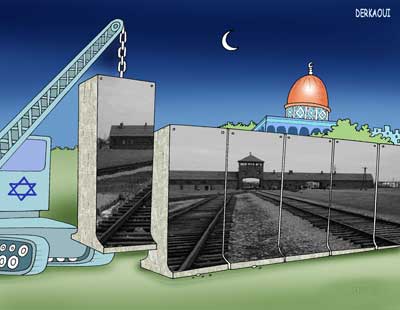
This is actually a pretty powerful cartoon. According to descriptions I've read, the image on the wall is of Auschwitz.
To describe the cartoon as anti-semitic would, of course, be a stretch, but I can see how supporters of Israel wouldn't like it.
Saturday, October 28, 2006
Draft Resolution: The Play with No Audience
The draft resolution that Europe (and the US) are presenting to the Russians and Chinese as their opening negotating position has been released.
I will not reproduce the entire thing here. And I may regret that when a final resolution is passed and I am not able to find this to compare it to. I'm including enough that I should be able to get the draft in a google search if it is there.
The second thing is that this draft does not seem to lack any of the elements of the Korean sanctions, which is to say that accepting this draft would equate Iran's IAEA supervised enrichment with Korea's test of a weapon.
What makes this a play is that nobody thinks the final document will look anything like this. When Rice said the sanctions we get will not look like what the US would produce unilaterally, she meant the sanctions we get will not look like this draft document.
A story is circulating in the Western press that the exemption for Bushehr makes this document a compromise between the Russians who want something less stringent and the US which wants something tougher. The difference is that Russia would prefer nothing to a resolution that is too stringent - and therefore has a credible veto threat. The US will take whatever it gets. So the final resolution will be the lowest common denominator - a little less stringent than the resolution that would provoke a Russian or Chinese veto.
I'm not sure who is supposed to be impressed by this dance over Bushehr.
I'm curious about whether or not the Europeans would present a resolution if they could not count on a Russian veto. The Iranians would take a resolution like this as a declaration of war, not a hot war, but Iran would do everything it could to increase the price of oil throughout the region and it would do everything it could to provoke the US to fire first starting a hot war.
The Iranians would also cut IAEA cooperation to at least the legal minimum. Removing cameras from safeguarded sites for example, and denying visas to inspectors from the West. I would expect Iran to announce it will withdraw from the NPT if after a set period, the sanctions have not been lifted. Iran has a history of making moves in this nuclear contest that are more subtle and clever than I expect though.
I will not reproduce the entire thing here. And I may regret that when a final resolution is passed and I am not able to find this to compare it to. I'm including enough that I should be able to get the draft in a google search if it is there.
16. Decides to establish, in accordance with rule 28 of its provisional rules of procedure, a Committee of the Security Council consisting of all the members of the Council, to undertake the following tasks:The first thing that strikes me about the draft is that the Security Council has to agree to lift sanctions. This would put the US into the Iraq position of getting sanctions, then announcing they will not be lifted without regime change.a) to seek from all States, in particular those in the region and those producing the items, materials, equipment, goods and technology referred to in paragraph 4 above, information regarding the actions taken by them to implement effectively the measures imposed by paragraphs 4, 5,7, 9 and 15 of this resolution and whatever further information it may consider useful in this regard,
The second thing is that this draft does not seem to lack any of the elements of the Korean sanctions, which is to say that accepting this draft would equate Iran's IAEA supervised enrichment with Korea's test of a weapon.
What makes this a play is that nobody thinks the final document will look anything like this. When Rice said the sanctions we get will not look like what the US would produce unilaterally, she meant the sanctions we get will not look like this draft document.
A story is circulating in the Western press that the exemption for Bushehr makes this document a compromise between the Russians who want something less stringent and the US which wants something tougher. The difference is that Russia would prefer nothing to a resolution that is too stringent - and therefore has a credible veto threat. The US will take whatever it gets. So the final resolution will be the lowest common denominator - a little less stringent than the resolution that would provoke a Russian or Chinese veto.
I'm not sure who is supposed to be impressed by this dance over Bushehr.
I'm curious about whether or not the Europeans would present a resolution if they could not count on a Russian veto. The Iranians would take a resolution like this as a declaration of war, not a hot war, but Iran would do everything it could to increase the price of oil throughout the region and it would do everything it could to provoke the US to fire first starting a hot war.
The Iranians would also cut IAEA cooperation to at least the legal minimum. Removing cameras from safeguarded sites for example, and denying visas to inspectors from the West. I would expect Iran to announce it will withdraw from the NPT if after a set period, the sanctions have not been lifted. Iran has a history of making moves in this nuclear contest that are more subtle and clever than I expect though.
Sunday, October 15, 2006
Allies in the War Against Terror: Why the US is breaking up Iraq
The leadership of the United States describes victory as an Iraq that is a "strong ally in the Middle East" defeat is described as a situation where extremists govern "a new terrorist state in the heart of the Middle East with large oil reserves that could be used to fund its radical ambitions". But if Iraq is to be democratic, there is a big problem. No population in the Middle East will, given the choice, elect leaders who are US allies in the war against terror. No Middle East population will keep extremists out of power if they fairly choose their own leaders.
Victory in Iraq, as the US defines it, requires the US to have leverage in Iraq sufficient to overrule its voters to ensure that Iraq is an ally in the war, and to prevent "extremists" from being brought to power there democratically. Leverage in Iraq is nearly impossible to maintain without boots on the ground. So the US needs a military presence in Iraq to prevent defeat.
"Extremism" as used by the US in the context of the Middle East means disbelief in the legitimacy of Israel. No group that does not accept Israel's legitimacy, regardless of distinctions such as secular vs. Islamist vs democratic vs tyrannical fails to be described as extemist. No group that does accept Israel, regardless of any other beliefs or policies, is described as extremist. Following the US lead, I use extremism and non-acceptance of Israel interchangeably.
Enter the Kurds. Most Kurds live in Turkey, where Kurdish separatists have been Turkey's primary security concern for over a generation. A wealthy independent Kurdistan from what is now Iraq is a mortal threat to Turkey because there would be no way to prevent it from supporting Kurdish separatists in Turkey. Kurds are viewed similarly by, but are substantially less threatening to Iran and Syria.
The Kurds of Iraq though, landlocked and surrounded by neighbors of various degrees of hostility, can use a US military presence to ensure that the neighbors do not intervene it its affairs. Without that presence, for example, Turkey and Iran would follow the PKK back into its bases and Iraq and flush them out there. The Kurdish militias, good though they would be if put against other Iraqi militias, are entirely unequipped to fend off national armies of Turkey or Iran. Turkey would also intervene to ensure justice for both the Sunnis and the Turkmen in the area of Kirkuk - denying that city and the oil from that area to any Kurdish confederation or state.
The US needs the Kurds because without the Kurds, the US cannot keep a military presence in Iraq, which means the US is defeated when extremists are voted into power. Specifically, the US needs the Kurds to have enough independence that they can host a US and even an Israeli(!) military presence despite the fact that the Sunnis and Shiites of any central government are sure to vote against that. This requirement means that de-facto partition of the country, at least, is necessary to prevent a US defeat in Iraq.
Further than that, the Kurds know the US both needs their assent and intends to remain indefinitely. That gives the Kurds leverage in their dealings with other Iraqis that allows them to make demands that otherwise would be unreasonable. The Kurds want their mini-state to have the power to make oil exploration deals independent of the central government. They want to limit the amount of revenue that is sent back to Baghdad and they want Kirkuk ceded to their region.
The leverage they bring is that if the Kurds feel forced, they can declare independence, and the US is forced to support them, otherwise the US would be defeated in Iraq. Without the knowledge of US support, the Kurds would not have a credible threat to secede. Secession would bring immediate defeat at the hands of Iraq plus Turkey and Iran.
A relationship has formed between the US and the Kurds where the Kurds are free to ask for and get economic arrangments and political and military autonomy that represent a de-facto partition of Iraq in themselves. The fuel of this relationship is the US imperative to avoid defeat, to prevent the acquisition by extremists of unchecked power in Iraq and control of Iraq's resources.
I have earlier commented that a foreign invader alone can be enough to begin a civil war spiral when formerly illegitimate organizations become legitimate fighters of the occupation. I used the example of Crips and Michigan Militia in an invasion of Michigan. In the case of Iraq, that is a very small part of the story.
The US relationship with the Kurds, and the de-facto secession the US must support for the Kurds puts Iraq's Shiites in the position that they are nearly forced to secede themselves.
In Iraq, Shiite areas produce approximately 60% of the oil, Kurdish areas the other 40%. So the Kurds who are about 20% of the population, and have the most oil per capita are going to get to keep their oil. The Shiites, which much less oil per capita are to share theirs with the Sunnis, who have none.
The Shiites are not going to accept that. As much as Iran would prefer Iraq remain stable, there is no way, if Iraq is going to break up anyway, for them to force the Shiites to stay with the Sunnis.
And if Iraq is going to break up, that means there is a new importance for creating facts on the ground. The question of whether the Shiite parts of Baghdad will connect with the Shiite state to the South and similar strategic questions are the major motivation for the current fighting. This race to create facts on the ground is not due to ethnic hatred, nor it is the inevitable result of the defeat of the Baathists, nor is it proof that only a tyrant can rule Iraq. This race, and the violence it brings with it, are due to the US need to effectively partition the country to maintain a military presence.
If the US was willing to accept defeat in Iraq, willing to accept an extreme government having full control or Iraq's resources including oil, then the civil war could be wound down even now. It certainly was never inevitable.
The constitution was negotiated with the understanding that the US intended to maintain a long-term presence in Iraq. If the US was willing to leave now, it could be amended so that oil revenues are divided equally per-capita among all provinces. Kurdistan could maintain cultural, and linguistic independence but its foreign policy would be set in Baghdad. Under those conditions, the Shiites would also remain in Iraq. The Kurds could not refuse this arrangement if the US was willing to leave because if Turkey and/or Iran intervene, which they would be willing to do, the Kurds would end up with less.
But since the US is not willing to accept defeat, Iraq will be violently broken up. This violent civil war is not the unpredictable outcome of a poorly executed occupation. It is the only possible result of an occupation of Iraq by the US given the way the US defines victory and defeat.
Victory in Iraq, as the US defines it, requires the US to have leverage in Iraq sufficient to overrule its voters to ensure that Iraq is an ally in the war, and to prevent "extremists" from being brought to power there democratically. Leverage in Iraq is nearly impossible to maintain without boots on the ground. So the US needs a military presence in Iraq to prevent defeat.
"Extremism" as used by the US in the context of the Middle East means disbelief in the legitimacy of Israel. No group that does not accept Israel's legitimacy, regardless of distinctions such as secular vs. Islamist vs democratic vs tyrannical fails to be described as extemist. No group that does accept Israel, regardless of any other beliefs or policies, is described as extremist. Following the US lead, I use extremism and non-acceptance of Israel interchangeably.
Enter the Kurds. Most Kurds live in Turkey, where Kurdish separatists have been Turkey's primary security concern for over a generation. A wealthy independent Kurdistan from what is now Iraq is a mortal threat to Turkey because there would be no way to prevent it from supporting Kurdish separatists in Turkey. Kurds are viewed similarly by, but are substantially less threatening to Iran and Syria.
The Kurds of Iraq though, landlocked and surrounded by neighbors of various degrees of hostility, can use a US military presence to ensure that the neighbors do not intervene it its affairs. Without that presence, for example, Turkey and Iran would follow the PKK back into its bases and Iraq and flush them out there. The Kurdish militias, good though they would be if put against other Iraqi militias, are entirely unequipped to fend off national armies of Turkey or Iran. Turkey would also intervene to ensure justice for both the Sunnis and the Turkmen in the area of Kirkuk - denying that city and the oil from that area to any Kurdish confederation or state.
The US needs the Kurds because without the Kurds, the US cannot keep a military presence in Iraq, which means the US is defeated when extremists are voted into power. Specifically, the US needs the Kurds to have enough independence that they can host a US and even an Israeli(!) military presence despite the fact that the Sunnis and Shiites of any central government are sure to vote against that. This requirement means that de-facto partition of the country, at least, is necessary to prevent a US defeat in Iraq.
Further than that, the Kurds know the US both needs their assent and intends to remain indefinitely. That gives the Kurds leverage in their dealings with other Iraqis that allows them to make demands that otherwise would be unreasonable. The Kurds want their mini-state to have the power to make oil exploration deals independent of the central government. They want to limit the amount of revenue that is sent back to Baghdad and they want Kirkuk ceded to their region.
The leverage they bring is that if the Kurds feel forced, they can declare independence, and the US is forced to support them, otherwise the US would be defeated in Iraq. Without the knowledge of US support, the Kurds would not have a credible threat to secede. Secession would bring immediate defeat at the hands of Iraq plus Turkey and Iran.
A relationship has formed between the US and the Kurds where the Kurds are free to ask for and get economic arrangments and political and military autonomy that represent a de-facto partition of Iraq in themselves. The fuel of this relationship is the US imperative to avoid defeat, to prevent the acquisition by extremists of unchecked power in Iraq and control of Iraq's resources.
I have earlier commented that a foreign invader alone can be enough to begin a civil war spiral when formerly illegitimate organizations become legitimate fighters of the occupation. I used the example of Crips and Michigan Militia in an invasion of Michigan. In the case of Iraq, that is a very small part of the story.
The US relationship with the Kurds, and the de-facto secession the US must support for the Kurds puts Iraq's Shiites in the position that they are nearly forced to secede themselves.
In Iraq, Shiite areas produce approximately 60% of the oil, Kurdish areas the other 40%. So the Kurds who are about 20% of the population, and have the most oil per capita are going to get to keep their oil. The Shiites, which much less oil per capita are to share theirs with the Sunnis, who have none.
The Shiites are not going to accept that. As much as Iran would prefer Iraq remain stable, there is no way, if Iraq is going to break up anyway, for them to force the Shiites to stay with the Sunnis.
And if Iraq is going to break up, that means there is a new importance for creating facts on the ground. The question of whether the Shiite parts of Baghdad will connect with the Shiite state to the South and similar strategic questions are the major motivation for the current fighting. This race to create facts on the ground is not due to ethnic hatred, nor it is the inevitable result of the defeat of the Baathists, nor is it proof that only a tyrant can rule Iraq. This race, and the violence it brings with it, are due to the US need to effectively partition the country to maintain a military presence.
If the US was willing to accept defeat in Iraq, willing to accept an extreme government having full control or Iraq's resources including oil, then the civil war could be wound down even now. It certainly was never inevitable.
The constitution was negotiated with the understanding that the US intended to maintain a long-term presence in Iraq. If the US was willing to leave now, it could be amended so that oil revenues are divided equally per-capita among all provinces. Kurdistan could maintain cultural, and linguistic independence but its foreign policy would be set in Baghdad. Under those conditions, the Shiites would also remain in Iraq. The Kurds could not refuse this arrangement if the US was willing to leave because if Turkey and/or Iran intervene, which they would be willing to do, the Kurds would end up with less.
But since the US is not willing to accept defeat, Iraq will be violently broken up. This violent civil war is not the unpredictable outcome of a poorly executed occupation. It is the only possible result of an occupation of Iraq by the US given the way the US defines victory and defeat.
Saturday, October 07, 2006
Baker going to Iran?
I'm late to get the pretty huge news that James Baker has been authorized to speak with the Iranians. I was directed to that link by way of the page of Trita Parsi, a real Iran expert at Johns Hopkins.
It is tempting to believe we are now watching an adjustment in US policy. The US cannot be a bumbling power whose worldview is entirely divorced from the real world forever.
Much was made of Ahmadinejad's meeting with the US Council of Foreign relations, and the State Department's decription of the meeting as a bad idea.
At the same time though, Bush authorized James Baker to speak directly with the Iranians. James Baker's continues to have close ties with the Bush administration. A meeting would open a direct channel of communication that while unofficial would be essentially as reliable as official communication.
Could this lead to a resolution of either the enrichment program or the dispute between the US and Iran over the legitimacy of Israel? It is hard to say yes to that because the positions are nearly irreconcilable.
Israel wants, and in fact needs, to be able to impose a unilateral resolution on the Palestinians if it is to continue as a Zionist state. There is no possible arrangement that the Palestinians would accept willingly that would leave the Palestinians either unwilling or unable to press Israel for further concessions, ending with the concession that the refugees return to outvote the Zionists.
Iran cannot, as a self-defined Islamic republic, go along with any arrangement that leaves Israel free to impose a unilateral resolution on the Palestinians. At best, this irreconcilable conflict could be resolved with a truce, putting off the end of Zionism for some amount of years with the understanding that after that period there will be rapid change if the Palestinians still want it. "Some amount of years" definitely would not mean 100 years, but something Iran's leaders can expect to see. Thirty years on the outside.
On enrichment, Iran would probably suspend temporarily for a significant improvement in its access to capital, which access is restricted now only by US unilateral sanctions.
The US cannot relax its restrictions given Iran's opposition to Israel because those restrictions are the only tools the US has to both pressure a change in Iran's anti-Israel policies or prevent Iran from becoming a dominant economic power in the region. Iran as a dominant economic power in the region is an equal or greater threat to Zionism than Iran as a nuclear capable military power. Iran though, seems to want to be both.
But Baker is going to Iran, which means the US is effectively ending its policy of non-negotiation with Iran.
The reality is that Iran cannot at this point be stopped from becoming a regional power. Iran also cannot be stopped from protecting the Palestinians from any resolution Israel tries to impose on the Palestinians unilaterally. This means that the Palestinians, if they want to, can expect to be able to end Zionism as an active political movement before the end of this century,
It is good news for the US that it appears to at least understand that reality even though it is most likely that the US has not decided how to deal with this reality.
It is tempting to believe we are now watching an adjustment in US policy. The US cannot be a bumbling power whose worldview is entirely divorced from the real world forever.
Much was made of Ahmadinejad's meeting with the US Council of Foreign relations, and the State Department's decription of the meeting as a bad idea.
At the same time though, Bush authorized James Baker to speak directly with the Iranians. James Baker's continues to have close ties with the Bush administration. A meeting would open a direct channel of communication that while unofficial would be essentially as reliable as official communication.
Could this lead to a resolution of either the enrichment program or the dispute between the US and Iran over the legitimacy of Israel? It is hard to say yes to that because the positions are nearly irreconcilable.
Israel wants, and in fact needs, to be able to impose a unilateral resolution on the Palestinians if it is to continue as a Zionist state. There is no possible arrangement that the Palestinians would accept willingly that would leave the Palestinians either unwilling or unable to press Israel for further concessions, ending with the concession that the refugees return to outvote the Zionists.
Iran cannot, as a self-defined Islamic republic, go along with any arrangement that leaves Israel free to impose a unilateral resolution on the Palestinians. At best, this irreconcilable conflict could be resolved with a truce, putting off the end of Zionism for some amount of years with the understanding that after that period there will be rapid change if the Palestinians still want it. "Some amount of years" definitely would not mean 100 years, but something Iran's leaders can expect to see. Thirty years on the outside.
On enrichment, Iran would probably suspend temporarily for a significant improvement in its access to capital, which access is restricted now only by US unilateral sanctions.
The US cannot relax its restrictions given Iran's opposition to Israel because those restrictions are the only tools the US has to both pressure a change in Iran's anti-Israel policies or prevent Iran from becoming a dominant economic power in the region. Iran as a dominant economic power in the region is an equal or greater threat to Zionism than Iran as a nuclear capable military power. Iran though, seems to want to be both.
But Baker is going to Iran, which means the US is effectively ending its policy of non-negotiation with Iran.
The reality is that Iran cannot at this point be stopped from becoming a regional power. Iran also cannot be stopped from protecting the Palestinians from any resolution Israel tries to impose on the Palestinians unilaterally. This means that the Palestinians, if they want to, can expect to be able to end Zionism as an active political movement before the end of this century,
It is good news for the US that it appears to at least understand that reality even though it is most likely that the US has not decided how to deal with this reality.
Thursday, October 05, 2006
Al Faisal Stresses Saudi Independence from the US
Condoleeza Rice was recently in the Middle East, trying to see if she could get any cooperation from the Gulf States, Egypt and Jordan against Iran. At least the public answer was no. I don't see any reason to believe that was not also the private answer.
But while Rice was speaking there, the Saudi Ambassador to the US decided to give a speech of his own. Just to make sure the United States hears what Rice heard from the allies of the US. It was an interesting speech, and breathtaking at one point.
The speech started in a charming way, a Mark Twain story promising not to speak too long.
Then the speech gets rolling, telling the Saudi side of the story about recent increased communications with the US. To hear the Saudis tell it, they need more communication to tell the Americans to solve the Palestinian crisis and to bring an immediate cease fire to the Lebanon war.
That is interesting in itself. Given that the US does not have much freedom of movement on the Palestinian problem - it certainly cannot force Israel to accept the Saudi offer of recognition in exchange for a full pullout to 1967 borders - to say that that is a requirement to solve other problems is to say the Saudis cannot help in other areas.
But then the speech turns devastating:
Ouch.
This is the Saudi Ambassador to the US. "Reform of campaign contributions" means "reduction of the power of pro-Israel lobbyists". I find that connection completely transparent. It could have been more explicit if he said that reform would allow the US to change its policy toward the Arab world which according the the Ambassador "must happen". I don't think a diplomat would be allowed to be any clearer than that about a country with which it is friendly.
Then we find that America's standing is in a slump in his Saudi Arabia, as well as in every Arab and Muslim country. "Arab and Muslim" means he is also speaking for Iran, as well as Iraq, Syria and Lebanon.
Iran's standing in Saudi Arabia was in a slump once. But that's over. This quotation is apparently from the question and answer session.
I predict that by this time in 2007, the Saudis will continue attempting to pressure the United States to pressure Israel to fully withdraw to the pre-1967 borders - which will fail. But under the cover of that failure, the Saudis will continue sounding more and more like the Iranians.
But while Rice was speaking there, the Saudi Ambassador to the US decided to give a speech of his own. Just to make sure the United States hears what Rice heard from the allies of the US. It was an interesting speech, and breathtaking at one point.
The speech started in a charming way, a Mark Twain story promising not to speak too long.
Then the speech gets rolling, telling the Saudi side of the story about recent increased communications with the US. To hear the Saudis tell it, they need more communication to tell the Americans to solve the Palestinian crisis and to bring an immediate cease fire to the Lebanon war.
I shall tell you now, how the Strategic Dialogue works. In the beginning of May, President Bush invited me to a "getting to know you meeting" at the White House. During a thorough review of issues, I made the point to the President that solving the Palestinian Problem will allow us to go on to solve the other problems in the area. Three weeks later, the meeting of the Strategic Dialogue took place.(link in original)
Prince Saud delivered to the President a letter from King Abdullah offering to work with the President in solving the Israeli-Palestinian dispute. The President, then, instructed Secretary Rice to follow up with Prince Saud on the details. Alas, the capture of the two Israeli soldiers led to the Israeli invasion, and destruction of Lebanon. The King sent Prince Saud back in July, to stress to the President the need for an immediate cease fire; and, again, to press for a solution to the Israeli-Palestinian dispute.
That is interesting in itself. Given that the US does not have much freedom of movement on the Palestinian problem - it certainly cannot force Israel to accept the Saudi offer of recognition in exchange for a full pullout to 1967 borders - to say that that is a requirement to solve other problems is to say the Saudis cannot help in other areas.
But then the speech turns devastating:
Americans want to see and hear about reform and change in Saudi society and political culture. This is on the agenda. But we’re not going to change just because you tell us to. We are changing and reforming our society because it is the right thing to do for our country. And we will do so in our own way, in accordance with our traditions and culture. Making dictums leads nowhere. Constructive comments, on the other hand, are more helpful.
We also want to see reform in the United States. Your reform of campaign contributions is essential and needed, yesterday, not tomorrow. Your policy towards the Arab World must change and be reformed in order to overcome the slump in America’s standing in my country, and in every other Arab and Muslim country.
Ouch.
This is the Saudi Ambassador to the US. "Reform of campaign contributions" means "reduction of the power of pro-Israel lobbyists". I find that connection completely transparent. It could have been more explicit if he said that reform would allow the US to change its policy toward the Arab world which according the the Ambassador "must happen". I don't think a diplomat would be allowed to be any clearer than that about a country with which it is friendly.
Then we find that America's standing is in a slump in his Saudi Arabia, as well as in every Arab and Muslim country. "Arab and Muslim" means he is also speaking for Iran, as well as Iraq, Syria and Lebanon.
Iran's standing in Saudi Arabia was in a slump once. But that's over. This quotation is apparently from the question and answer session.
"We have found in our experience that when we did not talk to Iran -- our relations were broken for a period of a few years in the '90s -- we had more troubles with each other. But since then, our relationship has improved dramatically and beneficially for both our countries"
I predict that by this time in 2007, the Saudis will continue attempting to pressure the United States to pressure Israel to fully withdraw to the pre-1967 borders - which will fail. But under the cover of that failure, the Saudis will continue sounding more and more like the Iranians.
Subscribe to:
Posts (Atom)